- Home
- Xi’an
XIY · Shaanxi
Xi’an
Ancient capital, walled and moated, with the country's most famous archaeological find half an hour outside it. Three days covers the essentials; four adds Mount Hua.
- Days needed
- 3 – 4
- Best months
- Mar – May · Sep – Oct
- Airports
- XIY Xianyang
- Rail hubs
- Xi'an North

Xi’an was China’s imperial capital for longer than any other city, and it is where the Silk Road began. Two things follow from that, and they anchor this Xi’an travel guide: an old town still bounded by a complete Ming-dynasty wall, and — half an hour outside it — the single most famous archaeological find of the twentieth century.
The Terracotta Army is the reason most visitors come, and it is worth building the first day around. The City Wall is the reason to stay a second: a closed 13.7 km loop, wide enough to cycle end to end, wrapped around a Muslim Quarter that is the best street food on this site’s western route. A fourth day reaches Mount Hua, a genuine excursion by high-speed train and cable car, not a stretch of the city itself.
How many days in Xi’an
Three days covers the core loop: Terracotta Army, City Wall, Muslim Quarter, Shaanxi History Museum, Big Wild Goose Pagoda. Order matters — the Army rewards an early arrival, the museum needs a reservation locked in a day ahead. See the 3-day itinerary for the stop-by-stop plan, or what there is to do in Xi’an for the fuller list of sights.
Four days adds Mount Hua (Huashan), about 28–30 minutes from Xi’an North by high-speed train, cable car up and cable car down. Reaching East Peak on foot for sunrise is a different trip: 6–8 hours of walking, normally overnight. A single day covers one of these, not both. The 4-day itinerary lays out which version you’re actually signing up for.
Getting to Xi’an
Xi’an Xianyang Airport (XIY) sits 45–50 km from downtown — an hour is a tight transfer budget, not a comfortable one. Xi’an North Railway Station, north of the walled city, is the hub for onward high-speed rail, about 30 minutes from the old town by metro.
From Xi’an North, the fastest train to Chengdu East takes 3 hours 7 minutes — full detail in the Chengdu–Xi’an train guide. Chongqing West is roughly 4 hours 40 minutes away at the fastest — see the Xi’an–Chongqing train guide. Beijing runs from around 4 hours 11 minutes on the same station’s G-trains.
Where to stay in Xi’an
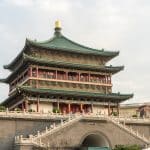
Four areas come up in Xi’an planning, and only two are general-purpose picks. The Bell Tower and City Wall core is the default first-timer base — the Wall, the towers and the Muslim Quarter sit a 5–20 minute walk apart, but it’s the most crowded, noisiest part of town. The Muslim Quarter itself is a louder sub-zone of that same core, worth staying in for the food stalls rather than for quiet — see what to eat in Xi’an for the dishes. Big Wild Goose Pagoda (Qujiang/Yanta) is quieter, built around the Shaanxi History Museum, on Metro Line 3. Near Xi’an North Station suits only travelers catching an early train to Huashan, Chongqing or Beijing — no sights sit near it. The full where-to-stay guide breaks down all four.
Best time to visit Xi’an
April and October get recommended for a reason that’s about temperature, not marketing. Spring (March–May) is dry, warming from 4–14°C to 14–26°C. Summer (June–August) is worth actively avoiding — highs regularly clear 35°C, and Huashan’s Plank Walk queue alone can run 2–4 hours in peak season before the heat gets added. Autumn (September–November) averages around 20°C, though September is the wettest month with real flood risk, leaving October as the standout — except its first week. Winter (December–February) is cold, dry, cheaper and quieter: Huashan’s mountain entrance drops from CNY 180 to CNY 100 in that window. See the month-by-month guide for the full breakdown.
National Day Golden Week (1–7 October) generates an estimated 800 million domestic trips nationwide, and Xi’an’s sights, trains and hotels all feel it. Travel from around 8 October instead.
What a Xi’an trip costs
Three days of paid admission — Terracotta Army, City Wall entry plus a bike rental, the Bell/Drum combo, the Great Mosque, and Big Wild Goose Pagoda’s grounds — comes to roughly CNY 330–345 per person (checked 24 Aug 2026), before food, transport and hotel. A fourth day at Huashan adds close to CNY 400 more in peak season for the entrance ticket plus both cable cars, less in winter. On the rail side, Xi’an–Chengdu starts from CNY 211 in second class (checked 14 Aug 2026), and Xi’an–Chongqing from CNY 384 (checked 24 Aug 2026) — often the bigger line item on a multi-city route.
Xi’an travel guide: quick answers
Is 3 days enough for Xi’an, or should I plan for 4?
Three days covers the Terracotta Army, the City Wall, the Muslim Quarter and the Shaanxi History Museum comfortably. A fourth day is only worth adding if Mount Hua is actually on the list — it’s a separate excursion, not an extension of the city itinerary.
Do I need to book the Terracotta Army in advance?
Not really. Entry is real-name, ID checked at the gate, with ticket batches released online about a week ahead — but same-day purchase at the ticket office is standard, not a fallback.
Do I need to book the Shaanxi History Museum in advance?
Yes. Admission is free but capped at 6,000 tickets a day, released only in four windows — 10:00, 11:00, 18:00 and 19:00 — through the museum’s own site or WeChat account. There’s no walk-up queue that reliably works.
Is a Huashan day trip from Xi’an realistic?
Yes, if you ride the cable cars both ways: about half an hour by high-speed train from Xi’an North, then up and down by cable car, and back the same evening. The sunrise hike to East Peak is an overnight trip, not a day trip.
The guides below are ordered the way you would read them when planning: the route first, then the individual decisions.
The Xi’an line
Nine guides, in the order you'd read them
Every destination on this site is built to the same nine-guide shape, so you always know what exists and where to find it.
-

-

-

-

-
-

-

-

-


Interchanges
Where the Xi’an line connects
-
Chengdu
G-train
from 3 h 07 -
Chongqing
G-train
from 4 h 40 -
Beijing
G-train
from 4 h 11