Harbin food starts from the same base as the rest of China’s northeast: big plates, plenty of salt, stews built for a long winter and sour pickled cabbage in more dishes than you’d expect. On top of that sits a second layer the Russians left. Harbin grew up around the Chinese Eastern Railway from 1898, and the railway decades gave the city a smoked sausage, a 2.5 kg rye loaf, kvass, a hotel ice pop and a brewery. Most lists mix the two layers without saying which is which. This one keeps them apart, prices what could be priced, and says so when a number couldn’t be found.
Guo bao rou, the dish Harbin says it invented
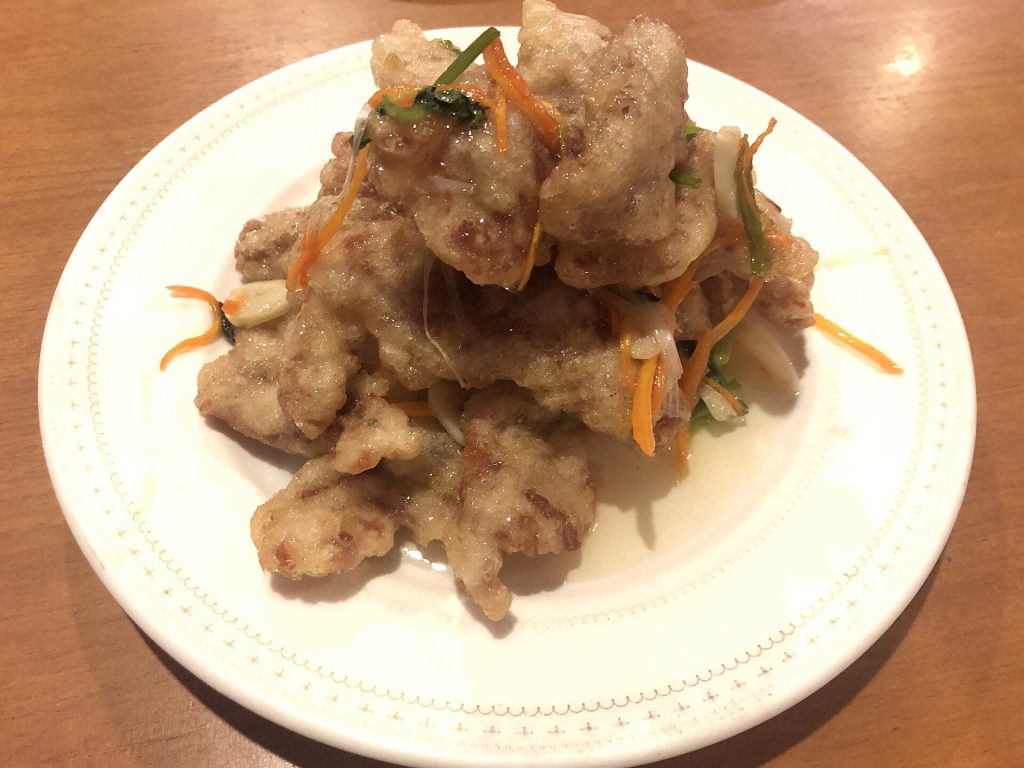
Guo bao rou (锅包肉), also written guobaorou, is sliced pork tenderloin, battered, fried twice and tossed in a sweet-sour sauce until the coating shines. Its origin story is unusually precise. In 1907 a cook named Zheng Xingwen went to work in the kitchen of the Binjiang circuit office, cooking for the intendant Du Xueying, who hosted a steady stream of foreign guests. Zheng turned a salty fried pork dish into a sweet-and-sour one to suit them. The name moved too: it began as 锅爆肉, “wok-burst pork”, and ended up as 锅包肉, “wok-wrapped pork”, a drift usually blamed on Russian diners who said bao the easy way.
The version to look for in Harbin is pale gold. The sauce is sugar and white vinegar, thin enough that the batter stays crisp. Further south, in Liaoning, cooks finish it with tomato sauce, which makes it redder and sweeter and, by the Harbin argument, softens the crust. If the plate arrives glossy orange, you’ve been served the Liaoning version.
Lao Chu Jia (老厨家) is the restaurant brand tied to the Zheng story. Its branch on the third floor of Balas Food City, 55-1 West 7th Street, is just off Central Street and opens 10:30-21:00; reviewers warn about queues at peak meal times. We couldn’t find a per-plate price for guo bao rou that we’d stand behind, there or anywhere else in the city, so there isn’t one here. Order it as a shared main.
Checked 28 Sep 2026 Origin (Zheng Xingwen, 1907, Du Xueying, name change) from Chinese Food Wiki; Harbin vs Liaoning sauce from Go China Freely; Lao Chu Jia address and hours from its Trip.com listing.
Harbin red sausage, and why it shouldn’t go home with you
Harbin red sausage (红肠, hongchang) is the food people carry out of the city. It’s a coarse pork-and-beef sausage, smoked over wood, heavy on garlic, with a reddish skin. Ask for Harbin sausage in English and you’ll be pointed to the same thing. The Churin company, a Russian trading house that set up in Harbin as the railway was completed in 1904, began making it in 1909, and its Chinese name, Qiulin (秋林), is still printed on the packets.
Churin Leader Foods (秋林里道斯) at No. 289-5 Jianguo Street lists a spend of ¥20-40 per person on Trip.com. HRL Since 1913 (红肠世家1913), near Central Street and St Sophia Cathedral, comes in at ¥30-50. Stalls across the centre also slice it to order.
The vacuum packs look travel-proof, and they are, right up to the arrivals hall. The United States, the EU, the UK and Australia all bar travellers from bringing pork products in from China, largely because of African swine fever, and undeclared meat can mean a fine. Eat it in Harbin or on the train out.
Checked 28 Sep 2026 Churin history (Harbin from 1904, sausage from 1909) from Wikipedia’s Churin and Qiulin entry; shop addresses and per-person spend from Trip.com’s Harbin food guide.
Dalieba and kvass, the Russian bakery shelf
Dalieba (大列巴) is a Chinese rendering of khleb, the Russian word for bread. The Harbin loaf is round, hard-crusted and about 2.5 kg, with a soft, slightly sour inside. It keeps for days, which is why people buy one for a long train ride. The Churin/Qiulin food shops sell it, and Babileke Russian Bakery (巴彼洛克俄罗斯西饼), opposite the Heilongjiang Art Museum, is the other name that keeps coming up, at ¥30-60 per person. Kvass (格瓦斯, gewasi) goes with it: a drink fermented from bread, faintly sour, under 1% alcohol. Qiulin bottles its own.
Checked 28 Sep 2026 Loaf weight from China Highlights; kvass alcohol content and Babileke spend from Trip.com.
Madieer ice pops at minus twenty
The Modern Hotel (马迭尔, Madieer) opened on Central Street in 1906, and the cold-drinks counter on its ground floor has sold a plain milk ice pop more or less ever since. Harbin eats them outdoors in January, which sounds like a dare and mostly is one. You’ll also see it sold as Madier ice cream. A plain one costs ¥5. The novelty versions, among them a frozen-pear flavor, one with birch sap and one with a splash of 53% baijiu, run ¥18-25. According to a March 2025 Tencent News report the shop sells about 22,000 a day, so the line moves quickly.
Checked 28 Sep 2026 Prices (¥5 plain, ¥18-25 novelty), flavors and daily sales from Tencent News, 23 March 2025.
Harbin Beer, brewed here since 1900
Harbin Beer (哈尔滨啤酒) dates to 1900, when Jan Wróblewski, a Pole from Tarczyn, opened a brewery to supply the new railway town. It’s often billed as China’s oldest brewery, a claim that gets repeated far more often than it gets documented. Anheuser-Busch took it over in 2004 after a bidding fight with SABMiller. In Harbin it’s simply the table beer: a light lager on every menu. The price depends on the restaurant rather than the beer, so we haven’t quoted one.
Checked 28 Sep 2026 Founding and takeover dates from Wikipedia’s Harbin Brewery entry, which also flags the “oldest” claim as uncited.
Iron-pot stew for a cold night
Tieguo dun (铁锅炖) comes from the farms and logging camps of the northeast. A huge cast-iron wok is set into the table and filled with chicken, fish, ribs or, classically, goose, plus potatoes, corn and beans, then left to stew while everyone sits around it. Cornbread dough pressed onto the hot rim bakes as the stew cooks. It’s a dish for four or more, not for one. Shan He Tun (山河屯铁锅炖), in the Central Street and St Sophia area, sits at ¥40-80 a head on Trip.com.
While you’re ordering northeastern plates, add di san xian (地三鲜): potato, eggplant and green pepper stir-fried together. It’s the vegetable dish on nearly every Dongbei menu, and a cheap way to balance a table heavy with pork.
Checked 28 Sep 2026 Iron-pot stew origin and Shan He Tun spend from Trip.com; di san xian from China Highlights.
Dumplings, Harbin-sized
Harbin dumplings are large, thin-skinned and packed full. Pork with suan cai (sour pickled cabbage) is the local default, with pork and chive or wild boar close behind. Two of the oldest names are in Daowai, the old Chinese quarter east of Central Street: Fan Jiyong (范记永), founded in 1912 at 222 Changchun Street, and Zhangbaopu (张包铺), dating from 1902, for steamed buns at the corner of Nanxun Street and Erdao Street. Closer to the tourist core, China Jiao Zi Wang (中华饺子王) runs ¥30-60 per person.
Checked 28 Sep 2026 Fan Jiyong and Zhangbaopu founding years and addresses from China Highlights; fillings and China Jiao Zi Wang spend from Trip.com.
Street food and the Hongzhuan morning market
Kao leng mian (烤冷面), grilled cold noodles, is Heilongjiang’s own street snack: a sheet of noodle griddled with egg, onion and coriander, brushed with a sweet-savory sauce and rolled up. Tanghulu, hawthorn berries in a hard sugar glaze on a stick, is everywhere in winter and stays crunchy in the cold. Frozen pears (冻梨, dongli) are the odd one. They turn black and rock-hard outside, and you soak one in cold water until a shell of ice forms on the skin and the flesh inside softens enough to bite.
For breakfast, head to the Hongzhuan Street morning market (红专街早市) in Daoli, on the stretch between Tongjiang Street and Jingwei Street. It runs 5:00-9:00 every day, and by nine the stalls are packing up. Look for sticky buns filled with bean paste, fried sugar cakes, bean-curd jelly (salty or sweet) and corn porridge.
Checked 28 Sep 2026 Grilled cold noodles and tanghulu from China Discovery and Trip.com; frozen-pear method from China Discovery; morning-market location, hours and dishes from China Educational Tours and Xinhua (24 Jan 2024).
A Russian dinner on Central Street
Huamei Western Restaurant (华梅西餐厅) has been at 112 Central Street since 1925 and is the obvious place for borscht and the Russian side of Harbin cuisine, with a menu of 40-odd signature dishes. For a sit-down northeastern meal in more comfortable surroundings, DingXiang XiaoZhen (丁香小镇) at 22 Zhaolin Street, Daoli, sits at ¥60-120 per person.
Checked 28 Sep 2026 Huamei address, founding year and menu from China Highlights; DingXiang XiaoZhen spend from Trip.com.
| Item | Price | Notes |
|---|---|---|
| Madieer plain ice pop | ¥5 | Central Street, March 2025 price |
| Madieer novelty flavors | ¥18-25 | Frozen pear, birch sap, baijiu |
| Red sausage shops | ¥20-50 | Churin Leader ¥20-40, HRL Since 1913 ¥30-50 |
| Dumplings, China Jiao Zi Wang | ¥30-60 | Central Street area |
| Russian bakery, Babileke | ¥30-60 | Opposite Heilongjiang Art Museum |
| Iron-pot stew, Shan He Tun | ¥40-80 | Best with four or more |
| Sit-down Dongbei, DingXiang XiaoZhen | ¥60-120 | 22 Zhaolin Street |
| Guo bao rou | Not confirmed | No per-plate price we could verify |
Checked 28 Sep 2026 Per-person figures are Trip.com listing averages; ice-pop prices from Tencent News. Restaurant spends move faster than ice-pop prices, so treat them as a guide.
Most of these addresses sit within walking distance of Central Street, which the three-day Harbin itinerary crosses on day one. The morning market is an easy add before the sights along the old Russian quarter, and if you’re coming for the ice, the Harbin in winter guide covers the clothing you’ll want for those outdoor ice pops. Everything else on the city is on the Harbin hub.
Summarised from published guides and public traveller discussion, not from a visit. We have not eaten in Harbin ourselves; see how we check.